Table of Contents
ToggleHow To Do The Sand Quality Test Before construction?
Poor-quality sand can weaken concrete, cause cracks, and shorten the life of a building.
That is why it is important to test sand quality before starting construction. In this blog, we explain both simple field tests and professional lab tests that can be used to determine if sand is suitable for construction. There are several methods by which the quality of sand can be tested.In real site conditions, engineers often notice that low-silt sand reduces rework and produces visibly smoother plaster finishes.
The Water Bottle Test
Particles in sand that are smaller than 150 microns are known as silt.
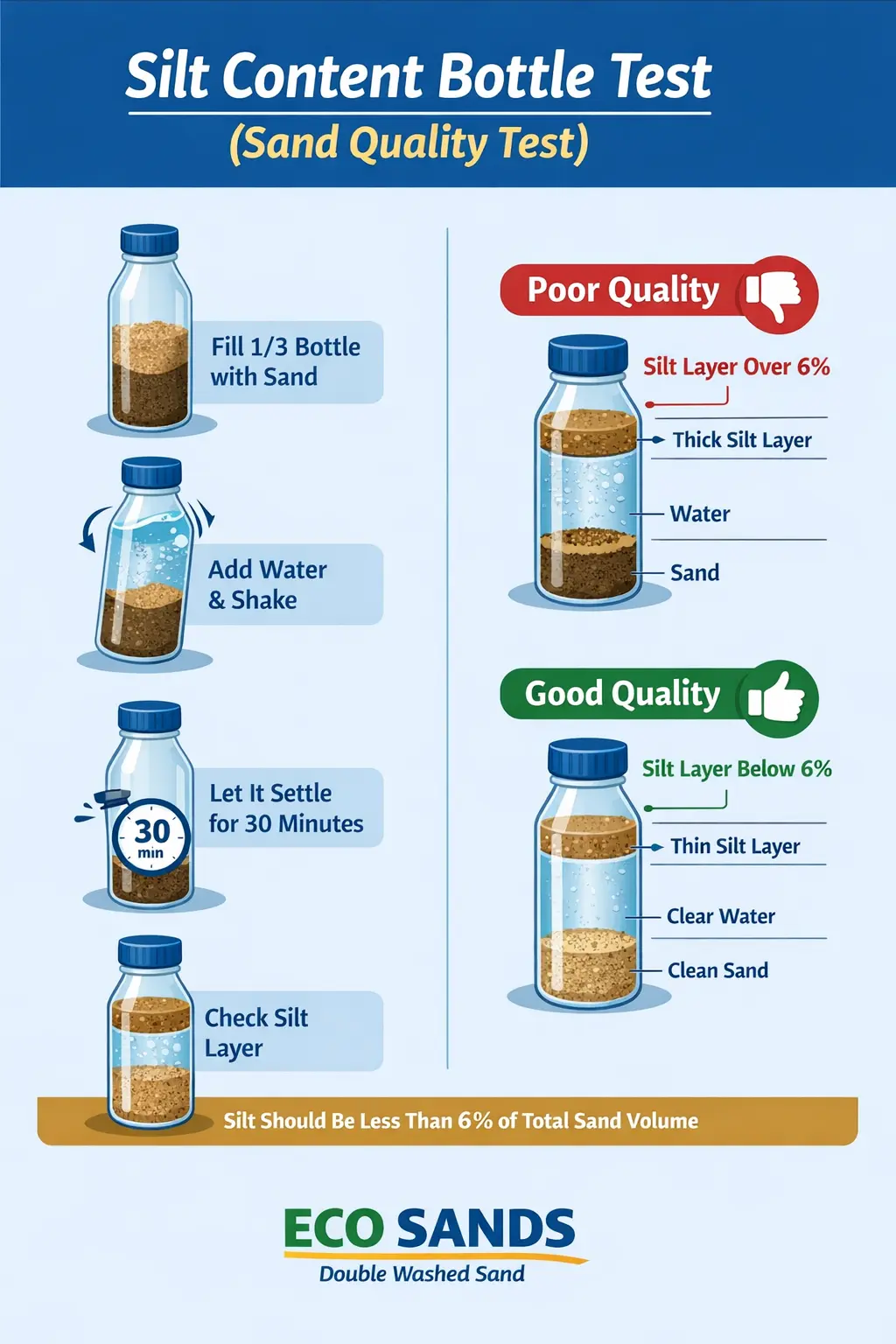
When there is too much silt in the sand, it can reduce the bond between cement and the aggregates. This can directly affect the compressive strength of concrete and mortar. High levels of silt also increase the amount of water needed, which can lead to shrinkage, cracks, and a poor surface finish. As part of a simple on-site sand quality test, take a clean, transparent bottle and fill it one-third with sand.Add clean water to fill the remaining two-thirds of the bottle. Close the bottle tightly, shake it thoroughly to separate the fine particles, and then place it on a flat surface. Allow it to sit undisturbed for 30 minutes.During this test, the heavier sand particles will settle at the bottom, while the lighter silt particles will form a visible layer on top.
This silt layer should not be more than 6% of the total volume of the sand. If the silt content is higher than this, the sand might lead to weak concrete, increased cement use, and inconsistent workability, making it unsuitable for high-quality construction.For important applications such as reinforced cement concrete (RCC) work, plastering, and high-end finishes, builders prefer sand that passes this test with minimal silt content.
Double washed sand, in particular, is processed multiple times to remove clay, dust, and very fine particles. This ensures better strength, improved workability, and long-lasting durability.Regular sand quality testing helps builders and contractors avoid problems related to materials and ensures the construction meets the required standards of quality and structure.At Eco Sands, internal quality checks are conducted before dispatch to ensure consistent silt limits across batches.
Choosing tested, low-silt sand is not just a choice for quality, but also a cost-saving measure in the long run.
Hand Rub Test
Rub sand between wet palms.
Sticky or smooth feel → high clay
Gritty feel → good-quality sand
Bulking of sand test
Add water slowly to sand and observe volume change.
Excess bulking = high moisture & impurities
Controlled bulking = better consistency
Laboratory Tests for Accurate Sand Results
Sieve Analysis
Checks particle size distribution
Ensures proper grading for plastering or concrete
Clay & Fines Content Test
Measures percentage of clay particles
Lower fines = stronger concrete
Specific Gravity Test
Indicates density and purity of sand
Eco Sands sand is batch-tested for consistency and strength
Comparing Sand Types Based On Quality
| Sand Type | Clay Content | Strength | Consistency |
|---|---|---|---|
| River Sand | Medium–High | Moderate | Unstable |
| Local Crushed Sand | High | Low | Inconsistent |
| Eco Sands (Double Washed) | Very Low | High | Consistent |
Why Quality-Focused Builders Choose Tested, Low-Silt Sand?
Skilled builders know that strong and durable construction starts with using high-quality sand.
Sand that passes a sand quality test has very little silt, which helps cement stick better, uses less water, and makes concrete and plaster stronger. If sand doesn’t pass a basic sand quality test, it can lead to cracks, weak mortar, and more material being used.
That’s why professionals choose sand that is regularly tested and meets strict quality standards.Many construction delays occur due to poor material quality, and sand failing a basic sand quality test is one of the most common hidden causes.
Sand that performs well in a sand quality test provides better mixing, smoother surface finishes, and longer-lasting structures. Double washed sand is especially useful because it removes clay and very fine particles that can lower the results of a sand quality test.
At Eco Sands, each batch is made to meet construction standards and pass important sand quality tests.Sand with high silt content may appear economical at purchase, but it increases cement consumption and long-term repair costs.
By selecting sand that consistently passes each sand quality test, builders can lower the risk of future repairs, keep costs under control, and ensure their structures are reliable. In today’s construction industry, choosing sand that passes a trusted sand quality test isn’t just an expense—Structures built using sand that consistently passes sand quality tests show better durability and reduced maintenance over time.